Research
How do rivers govern biological variation?
1. Ecomorphology, convergence, and adaptation
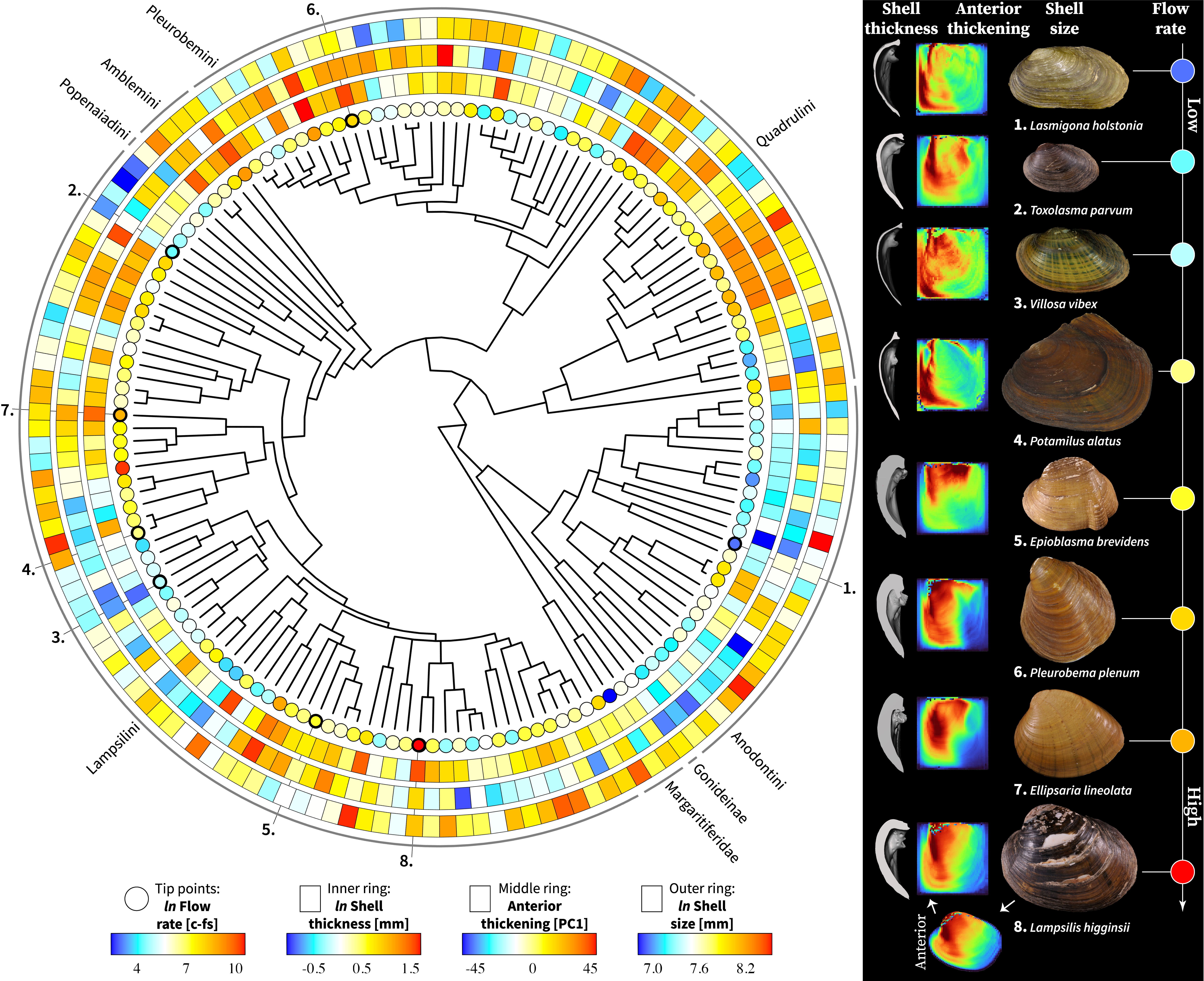 How repeatable is evolution?
Can macroevolutionary patterns best be described as contingent on historical events or conversely
deterministic, producing similar phenotypes in a given environment? A good barometer of the
repeatability of evolution is the degree to which lineages converge on similar phenotypic solutions
to shared environmental pressures. Freshwater habitats, with their unique fluid dynamics, exert
strong selective forces on the morphology of aquatic organisms and thus present an ideal system for
testing ecomorphological hypotheses. My work uses phylogenetic comparative methods and
high-throughput phenotyping to understand ecomorphological evolution of aquatic mollusks. Thus far,
my collaborators and I have shown that the shells of freshwater mussels are highly convergent. In
large river systems, mussels evolve thicker shells and conversely thinner shells in headwater
streams. See Keogh et al. 2024 for more information.
How repeatable is evolution?
Can macroevolutionary patterns best be described as contingent on historical events or conversely
deterministic, producing similar phenotypes in a given environment? A good barometer of the
repeatability of evolution is the degree to which lineages converge on similar phenotypic solutions
to shared environmental pressures. Freshwater habitats, with their unique fluid dynamics, exert
strong selective forces on the morphology of aquatic organisms and thus present an ideal system for
testing ecomorphological hypotheses. My work uses phylogenetic comparative methods and
high-throughput phenotyping to understand ecomorphological evolution of aquatic mollusks. Thus far,
my collaborators and I have shown that the shells of freshwater mussels are highly convergent. In
large river systems, mussels evolve thicker shells and conversely thinner shells in headwater
streams. See Keogh et al. 2024 for more information.
2. Phenotypic plasticity
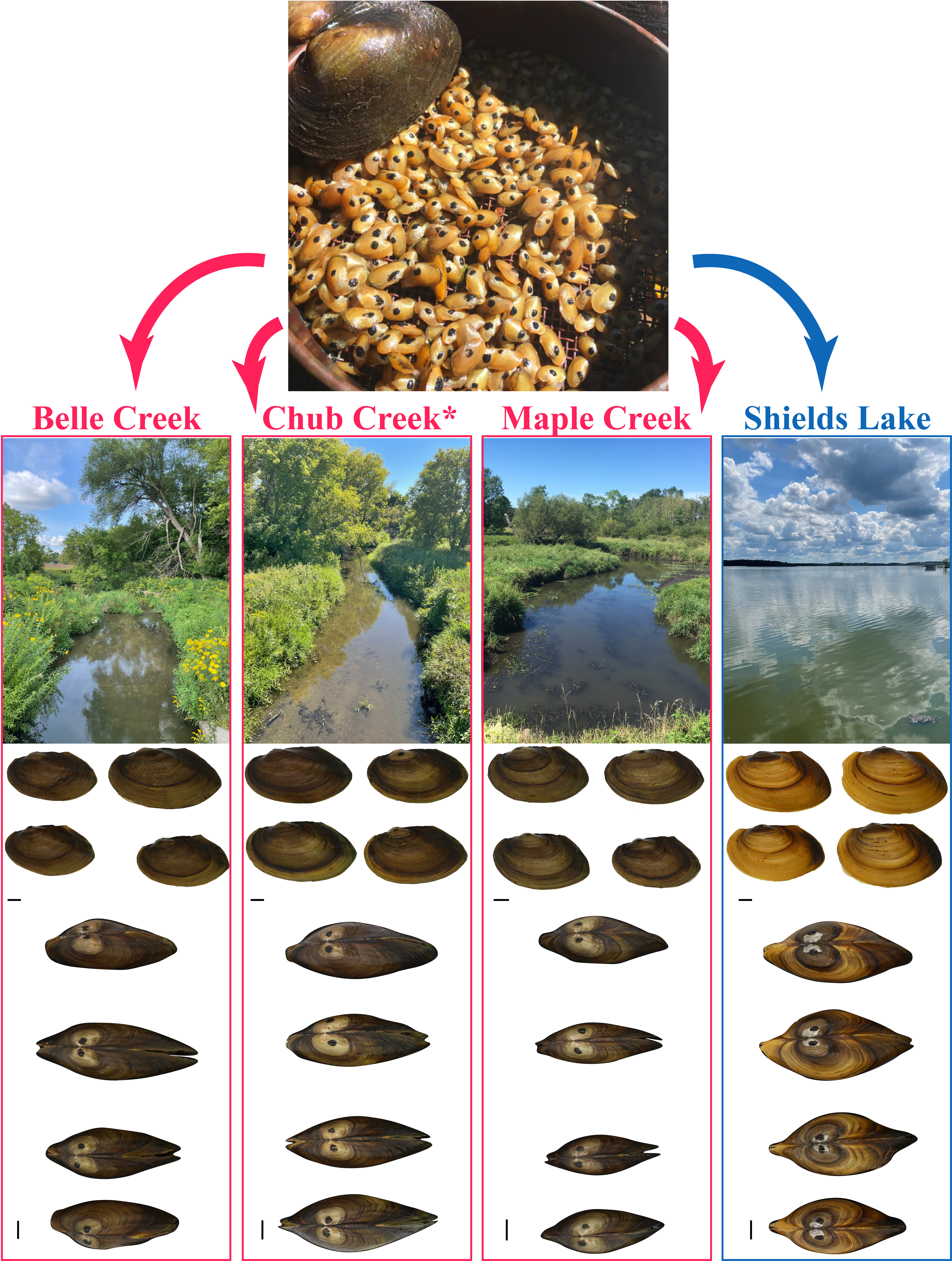 Globally, freshwater ecosystems
are undergoing rapid environmental change due to growing anthropogenic pressures. For aquatic
organisms, these complex environmental alterations represent novel physiological challenges,
which they must overcome in order to survive and reproduce. One strategy to maintain resilience
to environmental uncertainty is phenotypic plasticity, whereby a single genotype can develop
multiple phenotypes based on environmental cues.
Phenotypic plasticity has been shown to be a major biological mechanism in which organisms respond
to rapidly changing environments, including climate change. My collaborators and I have ran
multiple common garden and reciprocal transplant experiments to identify plastic responses of
freshwater mussels. We are currently using RNAseq of transplanted mussels to try to understand the
molecular pathways of plasticity. See Keogh et al. 2025 for a representative publication.
Globally, freshwater ecosystems
are undergoing rapid environmental change due to growing anthropogenic pressures. For aquatic
organisms, these complex environmental alterations represent novel physiological challenges,
which they must overcome in order to survive and reproduce. One strategy to maintain resilience
to environmental uncertainty is phenotypic plasticity, whereby a single genotype can develop
multiple phenotypes based on environmental cues.
Phenotypic plasticity has been shown to be a major biological mechanism in which organisms respond
to rapidly changing environments, including climate change. My collaborators and I have ran
multiple common garden and reciprocal transplant experiments to identify plastic responses of
freshwater mussels. We are currently using RNAseq of transplanted mussels to try to understand the
molecular pathways of plasticity. See Keogh et al. 2025 for a representative publication.
3. Speciation and biogeography
 The isolated river drainages of
eastern North America experienced repeated glacial expansion and recession throughout the Cenozoic,
resulting in cyclical periods of coalescence and isolation between neighboring river systems.
Landscape evolution mediated by climate change appears to be partially responsible for the great
diversity of freshwater mussels. Phylogeography and divergence dating of multiple mussel species
frequently show congruence between the timing of historical climatic fluctuations and
diversification events, suggesting drainage capture and isolation have played a dramatic role in the
proliferation of aquatic diversity. Concurrently, freshwater mollusks are one of the most imperiled
groups of animals globally. Ongoing species delimitation and conservation genomic work, identifying
new species and areas of high endemism, is critical to conserve these ecological engineers.
See Keogh et al. 2025 for a representative publication.
The isolated river drainages of
eastern North America experienced repeated glacial expansion and recession throughout the Cenozoic,
resulting in cyclical periods of coalescence and isolation between neighboring river systems.
Landscape evolution mediated by climate change appears to be partially responsible for the great
diversity of freshwater mussels. Phylogeography and divergence dating of multiple mussel species
frequently show congruence between the timing of historical climatic fluctuations and
diversification events, suggesting drainage capture and isolation have played a dramatic role in the
proliferation of aquatic diversity. Concurrently, freshwater mollusks are one of the most imperiled
groups of animals globally. Ongoing species delimitation and conservation genomic work, identifying
new species and areas of high endemism, is critical to conserve these ecological engineers.
See Keogh et al. 2025 for a representative publication.